Summary
When users purchase wellness supplements through an app or website, they usually commit to consuming them consistently for a period of three to six months. Since most of these products do not require a prescription, users typically rely on online stores for repeat purchases.
Supplements are commonly sold in bottles of 30, 60, or 120 tablets, with dosage varying between once or twice a day. This makes timely reordering essential to maintain consistency.
Consider Pranav, a working professional who decides to take an Omega-3 supplement. He purchases a bottle of 30 tablets and consumes one tablet daily. After following the routine consistently for 30 days, he reaches the last day of his supply and realizes he has forgotten to reorder.
Because delivery takes three to four business days, his routine breaks. Bulk ordering is not a viable option either, as these products often have limited shelf life due to their natural composition. This results in frustration, disrupted habits, and a poor overall experience for repeat users.
Understanding pain points
Through user interviews and usability testing on our initial draft, I observed that repeat buyers approach reordering very differently from first-time shoppers. Their primary goal is not discovery or comparison, but continuity.
From the research, three behavioral gaps emerged:
High effort for a simple task | Decision fatigue during reorder | Poor support for habit-building |
|---|---|---|
Reordering required the same effort as a fresh purchase, even though users already knew what they wanted. | Users were repeatedly exposed to options, promotions, and categories that were irrelevant to their immediate goal of replenishment. | The system treated every visit as a shopping session instead of recognising recurring consumption patterns. |
Problem Statement
Regular wellness supplement users need to keep getting their supplements on time, without overspending or overstocking.
Solution space
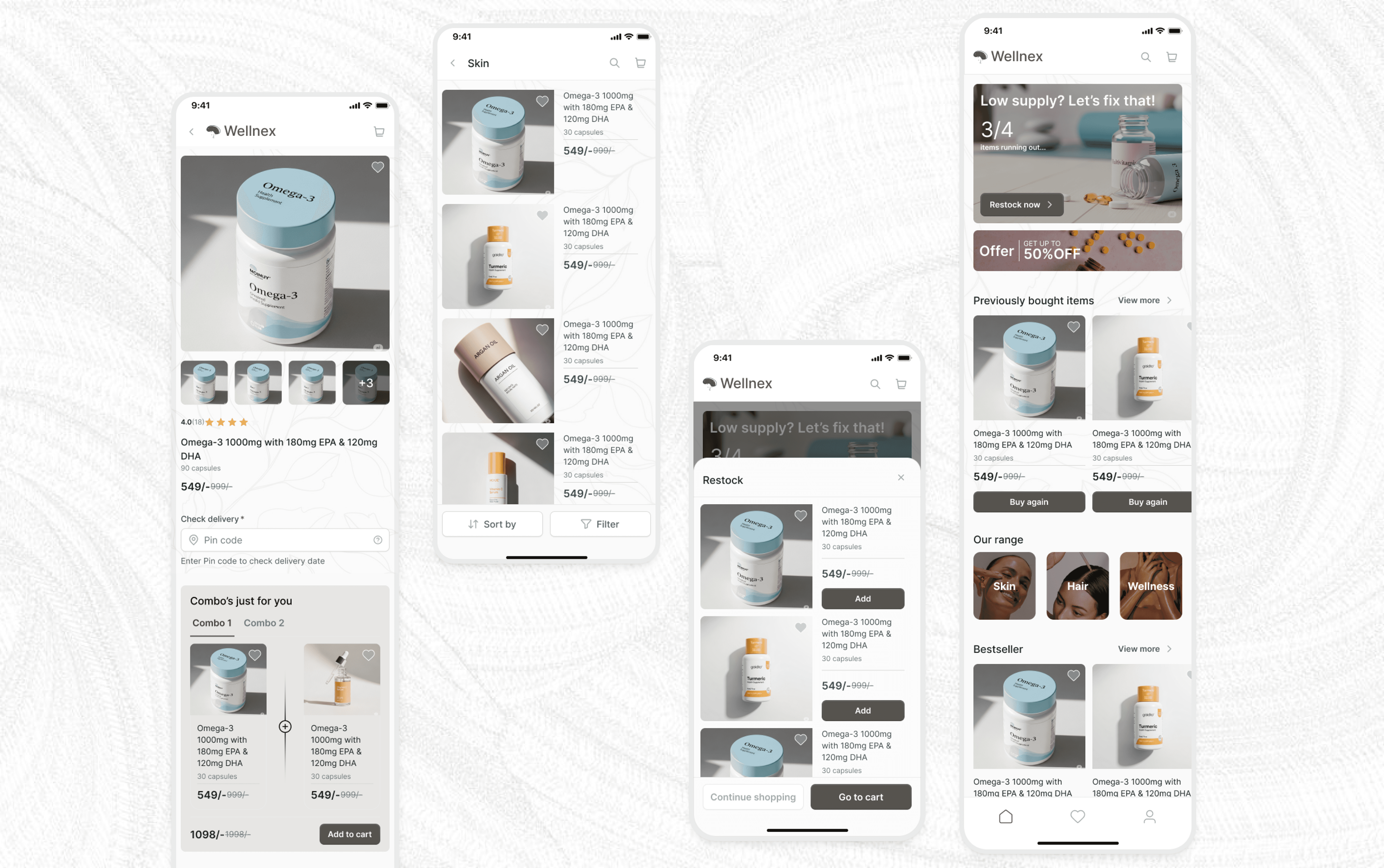
The 'Restock module'
To ensure users never run out of supplements while also avoiding over-stocking, the restock module focuses on timely, low-effort reordering.
Instead of encouraging browsing or product exploration, the experience is designed around proactive reminders when supplies run low and a fast, frictionless reorder flow that helps users complete restocking in just a few steps.
For products with predictable consumption cycles (for example, a 30-tablet pack), the system proactively surfaces a reorder action between day 24 and day 30 of the user’s cycle.
The goal is to reduce decision fatigue and make replenishment feel like a quick utility task rather than a shopping journey.
Here’s how the solution works:
Streamlined Navigation | Reduced Cognitive Load | Contextual Personalization |
|---|---|---|
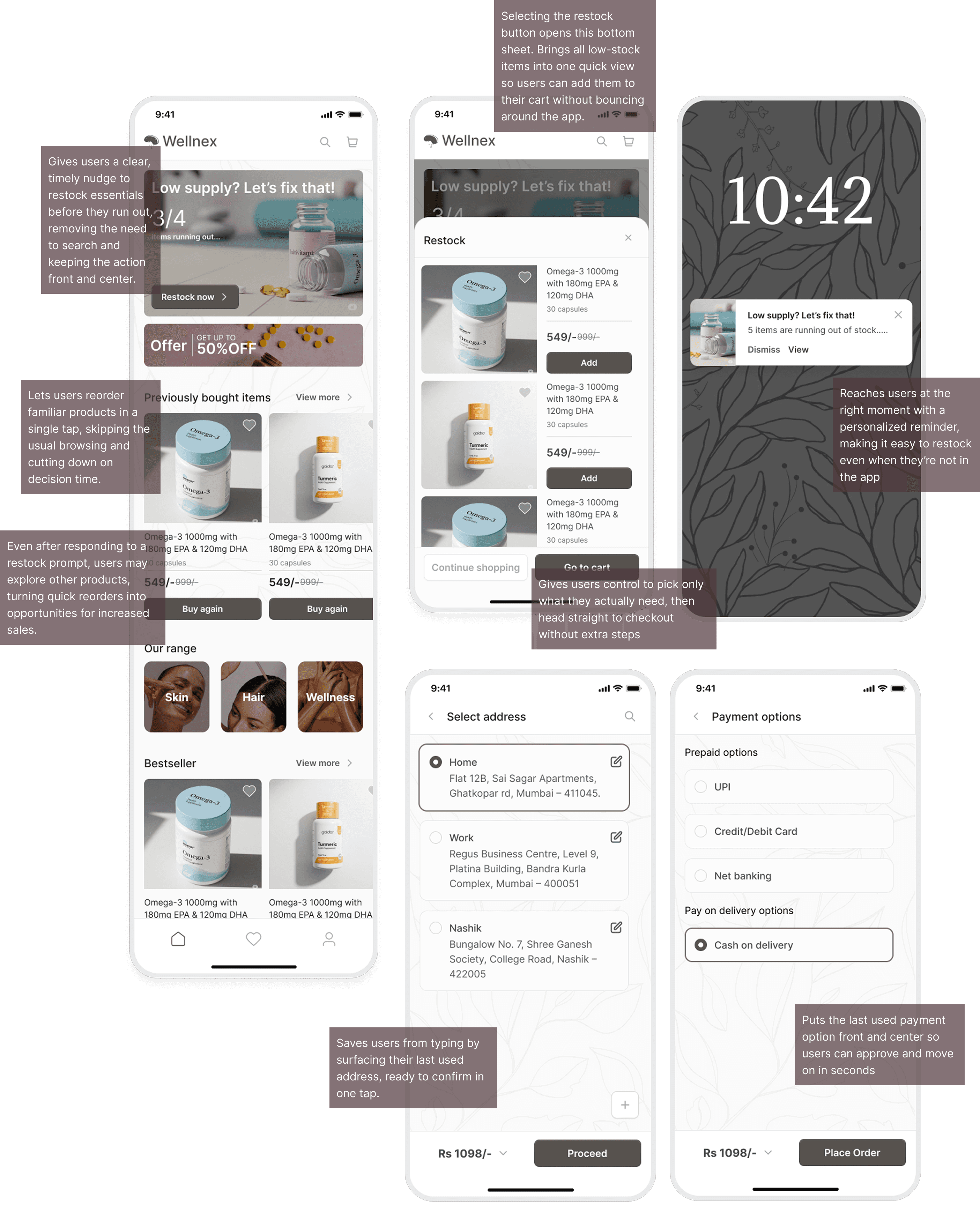
Placed the primary repeat action (“Buy Again” and “Restock”) in a persistent, high-visibility area on the home screen, reducing clicks and time-to-action. | Optimized the flow by eliminating redundant screens like navigating through the landing page and searching for a product. | Introduced a Reorder module that dynamically displays past purchases, allowing users to reorder with confidence and without searching. |
The updated design supports a faster, more intuitive repeat purchase flow, improving efficiency while making the experience feel relevant and user-centric.
By making repeat purchases feel almost automatic, we remove the extra thinking and clicking that slow users down. Timely restock reminders, a quick-add bottom sheet, and pre-filled address and payment details keep the flow smooth and familiar. It’s a journey that feels effortless for the user while also creating more chances for them to explore and buy.
Feedback and Testing
Approach
Usability Testing | Behavioral Observation |
|---|---|
Conducted moderated sessions with repeat and new users, asking them to complete a restock purchase using the redesigned flow. | Tracked how users interacted with the “Previously Bought” section over multiple sessions and saw a positive feedback on push notifications. |
Solutions like quick restock, pre-filled addresses, and default payment options streamlined the process. Also the proposal of warm, timely push notifications got positive feedback and we anticipate it to prompt reorders and encourage further browsing.
The result is a faster, more intuitive flow that is expected to boost reordering and subsequent cart building, driving higher cart value, confirmed by user feedback.
Conclusion
The separate reorder flow brought clarity and momentum to repeat purchases by combining restock, buy again, and quick reorder features into one seamless journey. Saved preferences and one-tap actions made the process predictable and fast, while reminders and suggestions encouraged users to return and explore. Together, these changes cut reorder time by nearly 50% and created a more engaging loop that builds loyalty, trust and higher lifetime value.